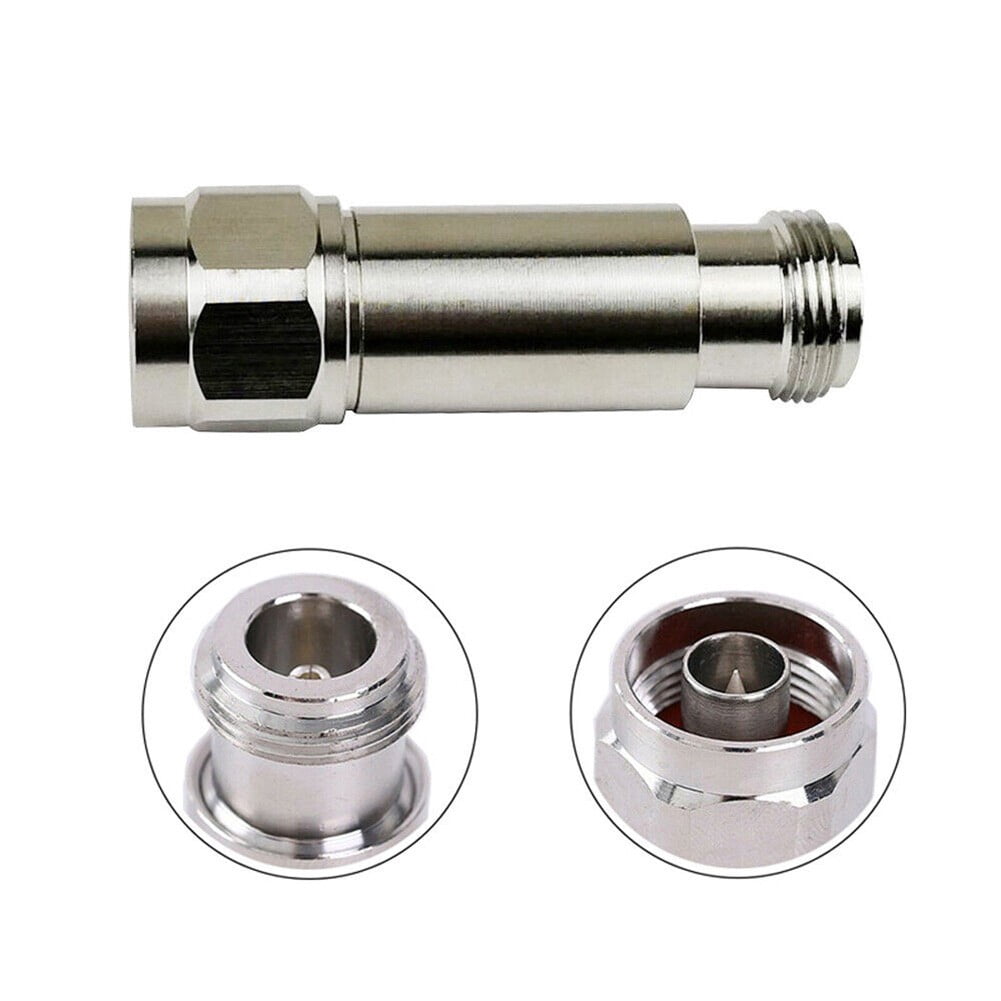
RF Coaxial Attenuator 2W 1dB-40dB N Type Male to Female DC-3.0GHz 50 Ohm Adjustable Attenuator for Signal Test
Product ID: TR-DZ-008514
A$43.95
In stock (checked 1 Nov 2026)
Secure checkout by Stripe. Order by email
- Price includes delivery to Sydney metro, other areas confirmed before dispatch. Outside Sydney metro we may contact you to confirm delivery, or refund you in full if we can’t deliver.
- Australian Consumer Law guarantees apply. Returns
- Questions? hello@toolrank.io
Details
Product Description
This 2W N-type male-to-female coaxial fixed attenuator delivers precise signal reduction from DC to 3GHz, making it an essential tool for RF testing, signal calibration, and communication system tuning. Built with copper-plated ternary alloy and tested under strict quality control standards, it ensures stable performance, low VSWR, and reliable 50-ohm signal transmission across a wide attenuation range.
Key Features
- Precise Signal Control: Fixed attenuation values let you reduce RF signal strength accurately for cleaner, more reliable measurements and transmissions.
- Wide Attenuation Range: Choose from 1dB, 2dB, 3dB, 5dB, 6dB, 10dB, 15dB, 20dB, 25dB, 30dB, 40dB, or 50dB models to match your exact signal attenuation needs.
- Broad Frequency Support: Operates from DC to 3GHz, ideal for a wide range of low-power RF and wireless applications.
- Stable, Low-Loss Performance: Standing wave ratio below 1.20 and 50-ohm impedance help maintain optimal signal integrity with minimal reflection.
- Rugged Copper-Plated Build: Sturdy copper-plated ternary construction with a compact design ensures durability and easy installation in tight setups.
- Wide Temperature Tolerance: Reliable operation from -55°C to +125°C suits demanding lab and field environments.
Specifications
Application Scenarios
Perfect for RF signal testing, lab measurement, antenna tuning, wireless communication systems, and ham radio setups. The male end (center pin) serves as the signal input and the female end (center socket) as the output, allowing quick plug-and-play installation between existing N-type connections.